Balykli Göl—Abraham’s Sacred Pond in the Heart of Şanlıurfa
There is a place in Şanlıurfa where history and legend are so tightly intertwined that they cannot be separated. Balyklygöl—“Lake of Fish”—consists of two ponds in the southwestern part of the city center that have been home to carp, considered sacred, for thousands of years. Tens of thousands of pilgrims and tourists come here every year: some to feed the fish and receive a blessing, others to touch the place where, according to legend, one of the most dramatic events in biblical history took place. Balyklygel holds layers of meaning—pagan, Jewish, Christian, and Islamic—and they all coexist here, just like those very carp in the green waters of the ponds.
The History and Origins of Balyklygel
The site now occupied by Balyklygel was revered long before the appearance of written sources. A statue found near the pond was dated to the Pre-Pottery Neolithic period—approximately 8,000–9,000 years BCE. This makes Balyklygöl one of the oldest continuously revered sites on the planet, although the form and content of worship have changed repeatedly over the millennia.
During the Hellenistic era, when the city was conquered by the armies of Alexander the Great and renamed Edessa by the general Seleucus I, the ponds became part of the cult of the Syrian goddess Atargatis. The goddess was worshipped in Syria, the Levant, and Mesopotamia; a distinctive feature of her sanctuaries were sacred ponds with fish, which were forbidden to catch and eat. Balyklygöl’s connection to this cult is reinforced by its Turkic name: balıklı means “fishy,” göl means “lake.” The fish were untouchable then—and remain untouchable today.
In the late antique period, the site was reinterpreted through the lens of the story of Abraham. The first written source is considered to be a 1st-century CE Jewish Haggadah attributed to Pseudo-Philo, which describes Nimrod’s attempt to burn Abraham alive. Later, this story entered rabbinic literature—in particular, the *Bereshit Rabbah*. The confusion arose due to the phonetic similarity between the ancient Hebrew word “or” (“fire, flame”) and the city of Ur of the Chaldeans: many commentators interpreted the words from the Book of Genesis, “I brought you out of Ur of the Chaldeans,” as referring to fire rather than the city, and associated this with Urfa.
The Christian pilgrim Egeria, who visited Edessa at the end of the 4th century CE, described ponds with remarkable fish—“of such size, so bright, and so delicious that I had never seen the like before.” But she attributed their origin not to Abraham, but to a later story: according to the local bishop, the springs miraculously gushed forth when the Persians tried to cut off the city’s water supply during a siege.
In Islamic tradition, the story of Abraham and Nimrod has become particularly firmly established. According to legend, Nimrod, enraged by Abraham’s refusal to worship idols, threw him into a huge bonfire, but God turned the fire into water and the firewood into sacred carp. This is how Halil-ür Rahman Gölü (Lake Halil-ür Rahman) came to be; the neighboring pond, Aynzeliha, was formed from the tears of Nimrod’s daughter Zeliha, who fell in love with Abraham and jumped into the fire after him. According to legend, anyone who drinks water from Aynzeliha will go blind.
The current appearance of the pond complex was shaped by a restoration project designed by architect Merih Karaaslan in consultation with Behruz Cinici. The project began in 1992, and the main part of the work was completed by 2000. The Halil-Rahman and Rizvaniye mosques, standing by the ponds, replaced the earlier synagogue and church.
Architecture and What to See
Balyklygöl is, above all, an atmosphere and a living tradition, rather than individual architectural masterpieces. Nevertheless, several significant sites are concentrated around the ponds.
The Pond Complex: Halil-ür Rahman and Aynzeliha
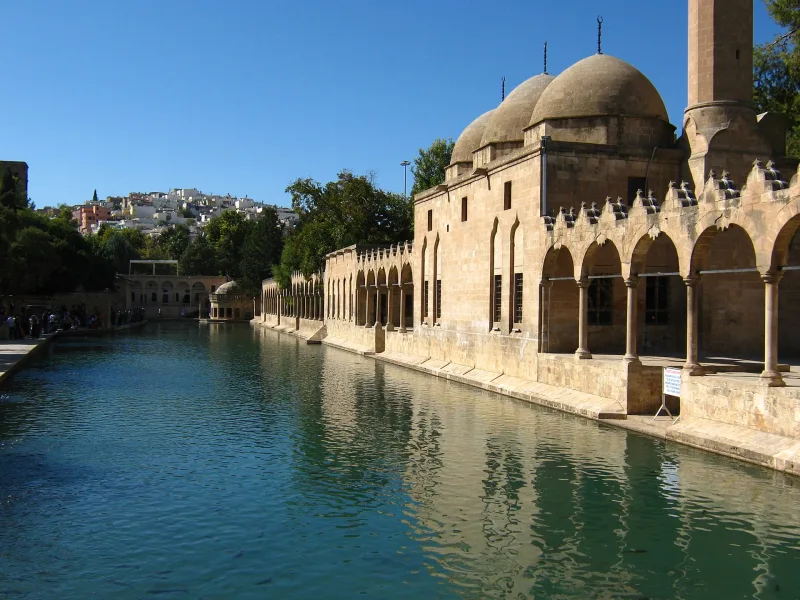
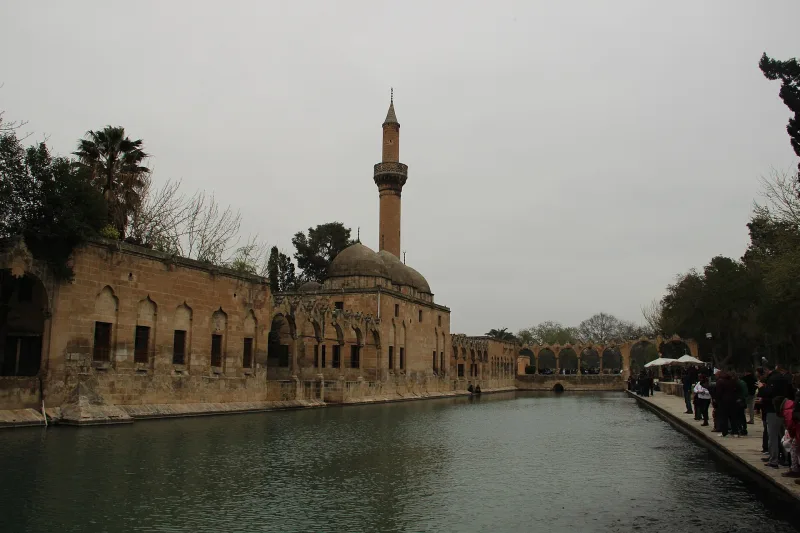
Two ponds—Halil-ür Rahman (the main, larger one) and Aynzeliha (a small one nearby)—are located on a plateau in the southwestern part of Şanlıurfa’s historic center. The water in the ponds has a distinctive greenish tint, and large carp literally swarm at the surface, drawn by the food thrown in by visitors. The fish here are truly enormous: no one has touched them for decades, and they grow to impressive sizes. Feeding the fish is a ritual that unites pilgrims of various faiths.
The Halil-Rahman Mosque and the Rizvaniye Mosque
On the shores of Halil-ür Rahman stand two mosques, framing the pond from opposite sides. The Halil-Rahman Mosque—with its white minaret—literally hangs over the water, creating one of the most photographed views of Şanlıurfa. The Rizvaniye Mosque, with its two slender minarets, completes the panorama from the other side. Both buildings were constructed during the Ottoman period, replacing earlier religious structures on the same site.
Abraham’s Cave (Makam-ı İbrahim)
To the southeast of the ponds lies the Makam-ı İbrahim Mosque and Cave—a site considered in local tradition to be the cave where Abraham was born. The cave is carved into the rock massif; inside is a prayer area and a small spring. This place is particularly revered by Muslim pilgrims.
Roman Columns on the Acropolis
The ruins of two Roman columns have been preserved on the ancient acropolis of Şanlıurfa. In the 17th century, the Ottoman traveler Evliya Çelebi interpreted them as the remains of Nimrod’s catapult, from which he allegedly hurled Abraham into the fire.
Interesting facts and legends
- The "Urfa Man" statue, found in the vicinity of Balıklıgöl, dates back to approximately 9,000–10,000 BCE and is considered one of the oldest natural human sculptures in the world.
- According to local legend, eating carp from Balıklıgöl will blind anyone who tries it. Researchers note that the roe of large carp is indeed poisonous when consumed in large quantities—meaning the legend has a biological basis.
- The confusion between the city of Ur in Iraq and the word “fire” in Jewish texts led to a chain of reinterpretations: Ur → “or” (flame) → Urfa. Modern Jewish sources acknowledge that the biblical Ur is the Iraqi city, not Şanlıurfa.
- Until the 1970s, townspeople swam in the ponds and swimming competitions were held there. After the ponds were officially designated as a sacred site, swimming and fishing were banned.
- The legend of Zeliha and her tears, which formed the nearby Aynzeliha pond, is unique to Şanlıurfa—it is a local Islamic tradition not found in other versions of the story of Abraham and Nimrod.
How to get there
Şanlıurfa has the GAP International Airport (GNY), which receives flights from Istanbul and Ankara. The distance from the airport to the city center is about 10 km by taxi or city bus. Balıklıgöl is located in the southwestern part of the historic center; it is about a 10–15-minute walk from Cumhuriyet Square to the ponds. Taxis in the city are inexpensive, and dolmuşes run regularly.
It is convenient to travel by bus from other cities in Southeastern Anatolia: about 2.5 hours from Gaziantep and about 3 hours from Diyarbakır. The Şanlıurfa bus station (otogar) is connected to the city center by minibuses.
Tips for travelers
Balykli Göl is open 24 hours a day and free of charge. The best time to visit is early morning or evening: there are fewer people, and the light on the water and the mosques is beautiful. On Fridays and holidays, the pond complex is particularly lively—hundreds of pilgrims come to pray and feed the fish.
Remember that the pond complex is an active religious site. Dress modestly; women are advised to carry a headscarf. Do not take close-up photos of people praying without permission. You must remove your shoes to enter the mosques.
Near the ponds lies the historic Şanlıurfa Bazaar, with traditional stalls run by coppersmiths, weavers, and jewelers—a great place for souvenirs. The local cuisine is superb: çiğ köfte (spicy bulgur meatballs), lahmacun, and baklava are must-tries.
To fully explore the region, combine a visit to Balıklıgöl with a trip to the Şanlıurfa Archaeology Museum, home to the “Urfa Man” statue, and a visit to Göbekli Tepe—15 km north of the city. Together, they paint a picture of humanity’s unbroken spiritual quest spanning twelve thousand years. Balykli Göl is not just a pond with fish: it is a living archive of diverse conceptions of holiness, layered upon one another over millennia.